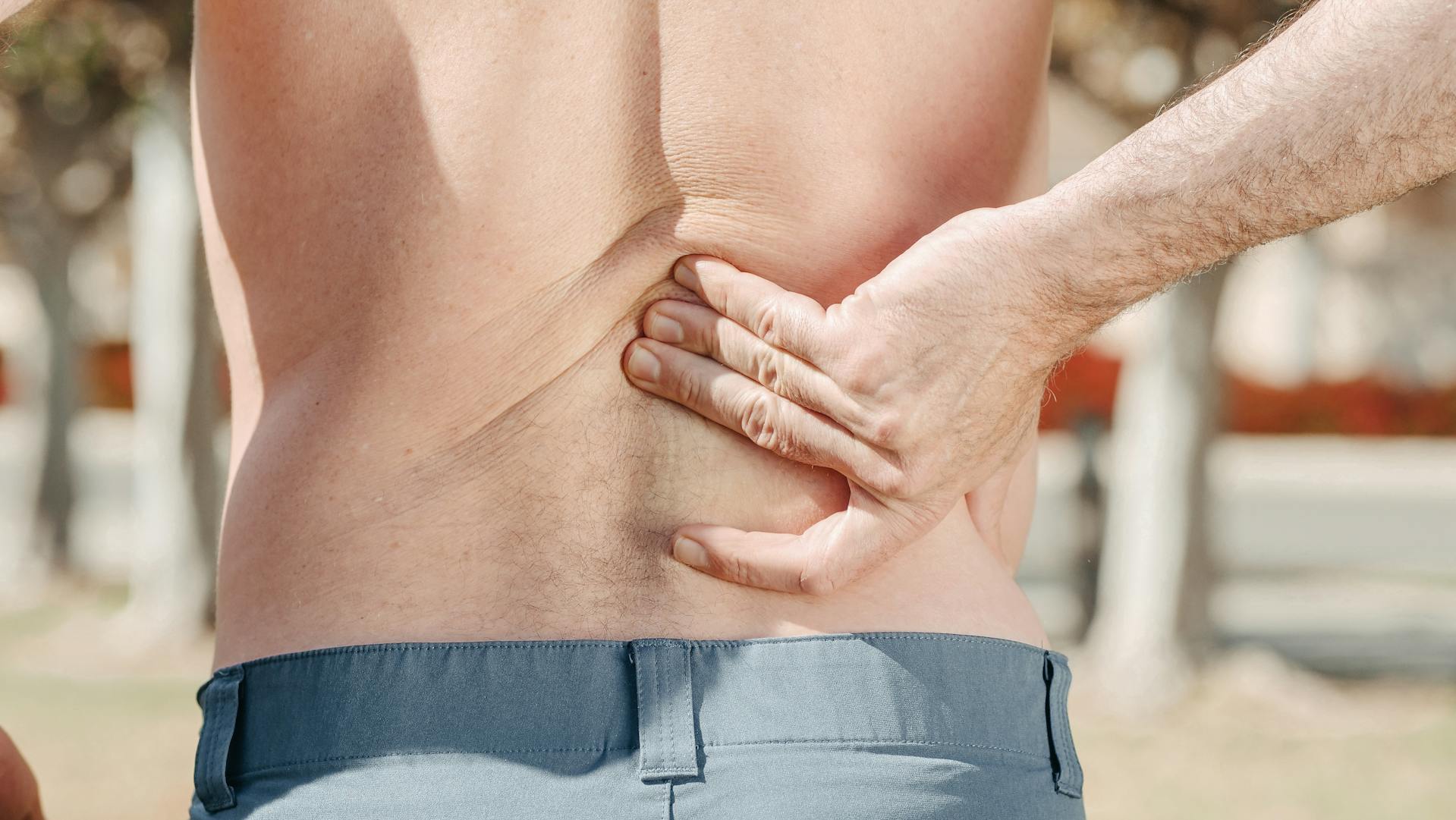
The short answer. A herniated disc in the lower back usually causes pain that shoots from the buttock down one leg (sciatica), and one in the neck causes pain that travels into the shoulder and arm, often with numbness, tingling or weakness1,2,3. Most people improve over weeks to a few months without surgery1,2. Loss of bladder or bowel control, or numbness between the legs, is an emergency1,4.
A herniated disc happens when the soft center of a spinal disc pushes through its tougher outer ring1. The disc material can squeeze a nearby nerve, and it also releases chemical irritants that inflame the nerve1. If you want the anatomy first, our post on spinal discs explains how a disc is built and why it changes with age.
The pain most often occurs on one side of the body2. Where you feel it depends on which disc is involved. The lower back is the most common site, the neck is second, and discs in the upper and mid back are rarely involved2.
Low back pain is usually the first symptom, and it may last a few days and then improve1. The symptoms that point more clearly to a disc are in the leg:
The pain may get worse when you sneeze, cough or laugh, bend backward, or strain, such as during a bowel movement2.
A disc in the neck can pinch a nerve root where it leaves the spinal cord, a condition called cervical radiculopathy3. The pain usually starts at the neck and travels down the arm, and people often describe it as burning or sharp3. Turning the head or extending the neck may make it worse3. Other symptoms include:
A disc is only one cause of a pinched nerve in the neck. In a population study of 561 people in Rochester, Minnesota, a confirmed disc protrusion caused 21.9% of cases, while 68.4% were related to spondylosis (age-related changes in the spine), the disc, or both5.
Rarely, a herniated disc in the lower back compresses the bundle of nerve roots at the bottom of the spinal canal, called the cauda equina. The American Academy of Orthopaedic Surgeons (AAOS) calls cauda equina syndrome a surgical emergency4. See a doctor immediately if you have4:
Without prompt treatment, cauda equina syndrome can cause permanent problems, including paralysis and loss of bladder and bowel control4. Emergency surgery is usually recommended to relieve the pressure, and it may keep that pressure from reaching the point where nerve damage is irreversible4. Earlier treatment offers the best outcomes, and early intervention has been linked with a greater chance of nerve recovery4,6.
Diagnosis starts with your history and a physical exam. A neurological exam checks strength (for example, walking on your heels and toes), feeling to light touch, and the reflexes at the knee and ankle1. In the straight leg raise test, you lie on your back while the doctor lifts the affected leg with the knee straight; pain that travels below the knee is a strong sign of a herniated disc1.
Imaging is not always needed right away. The American College of Radiology describes uncomplicated acute low back pain, with or without sciatica, as a self-limited condition that does not warrant imaging7. Imaging is considered if symptoms have not improved after up to six weeks of medical care and physical therapy, or sooner when there are red flags7. When it is done, an MRI can confirm the herniation and show which nerves are affected1. A plain x-ray cannot diagnose a herniated disc on its own2. Nerve tests such as electromyography can help pin down which nerve root is involved2,3.
Scans have to be matched to your symptoms. In a review of imaging in 3,110 people with no back pain, disc protrusions were found in 29% of 20-year-olds and 43% of 80-year-olds8. AAOS notes that nearly half of middle-aged and older people have worn discs and pinched nerves that cause no painful symptoms3.
Usually, yes. AAOS says most people with a herniated disc in the lower back improve slowly over days to weeks and are typically free of symptoms by 3 to 4 months, though some have flare-ups along the way1. Only a small percentage need surgery1.
The body can also clear the disc material itself. A meta-analysis of 11 cohort studies found spontaneous resorption in about 67% of lumbar herniations treated without surgery9. A separate review found the odds depend on the type of herniation10:
| Type of herniation | Regressed on repeat imaging [10] |
|---|---|
| Sequestration | 96% |
| Extrusion | 70% |
| Protrusion | 41% |
| Bulge | 13% |
These figures come from repeat scans, so they describe what happened to the disc on imaging, not a promise about how any one person will feel.
The neck follows a similar pattern. In the Rochester study, 90% of people were free of symptoms or only mildly limited at their last follow-up, and the problem came back in 31.7% over a median follow-up of 4.9 years5. In the lower back, AAOS puts the lifetime chance of the same disc herniating again at up to 20% to 25%1.
Treatment usually starts without surgery1:
For the neck, AAOS also lists a soft collar for a short time and a short course of oral steroids3. These treatments help relieve symptoms while the body works to heal the disc, and in many cases the herniated material dissolves and is absorbed over time1.
An epidural steroid injection places a cortisone-like medicine in the space around the irritated nerve to reduce inflammation1. AAOS says there is good evidence that these injections relieve pain in many patients whose symptoms continue after 6 weeks or more of other nonsurgical care1. MedlinePlus says they may help control pain for several months, reducing swelling around the spinal nerve and disc and relieving many symptoms2. A 2012 meta-analysis of 23 trials in people with sciatica found that epidural steroid injections gave short-term relief of leg pain and disability, measured from more than 2 weeks up to 3 months11.
In a 2020 Cochrane review, the side effects reported in the trials were mostly minor, such as increased pain during or after the injection and headache12. AAOS also notes some data suggesting a slightly higher infection risk if an injection is given within 3 months of surgery1.
AAOS recommends considering surgery when painful symptoms continue after a period of nonsurgical treatment, or when there is muscle weakness, difficulty walking, or loss of bladder or bowel control1. The most common operation for a single herniated disc is a microdiskectomy, which removes the herniated part of the disc through a small incision1. AAOS describes the results as generally very good: leg pain tends to improve more than back pain, most patients get back to their normal activities after a recovery period, and pain is usually the first symptom to improve, followed by leg strength and then sensation1. Risks include a tear in the covering of the nerves, a blood collection pressing on a nerve, and the disc herniating again1.
In trials comparing the two approaches, patients improved with both:
Timing is part of the decision. AAOS notes that studies suggest surgery done before about 9 months gives better results than surgery at around 9 to 12 months, and that your doctor will talk with you about how long to try nonsurgical treatment before considering surgery1.
Get care promptly for the red flags above, and book a visit for back or neck pain that is severe, does not go away, or comes with numbness or weakness2,4.
If you are in the Santa Barbara area, Dr. Scheinberg can examine your back or neck, review any imaging and talk through the options. Patients outside the area can have the first consultation by telemedicine, with imaging sent by email. See spine and back care or call (805) 682-1394.
Short answers to the questions patients ask most.
Have a question about your own situation?
Call (805) 682-1394In a herniation, the soft center pushes through the outer ring; in a bulge, the ring bulges outward instead1. Bulges are common on scans of people without pain, found in 30% of 20-year-olds and 84% of 80-year-olds8. Our spinal discs post covers the anatomy.
Reviewed by Dr. Richard Scheinberg, MD, a board-certified orthopedic surgeon in Santa Barbara with 40 years of surgical experience.