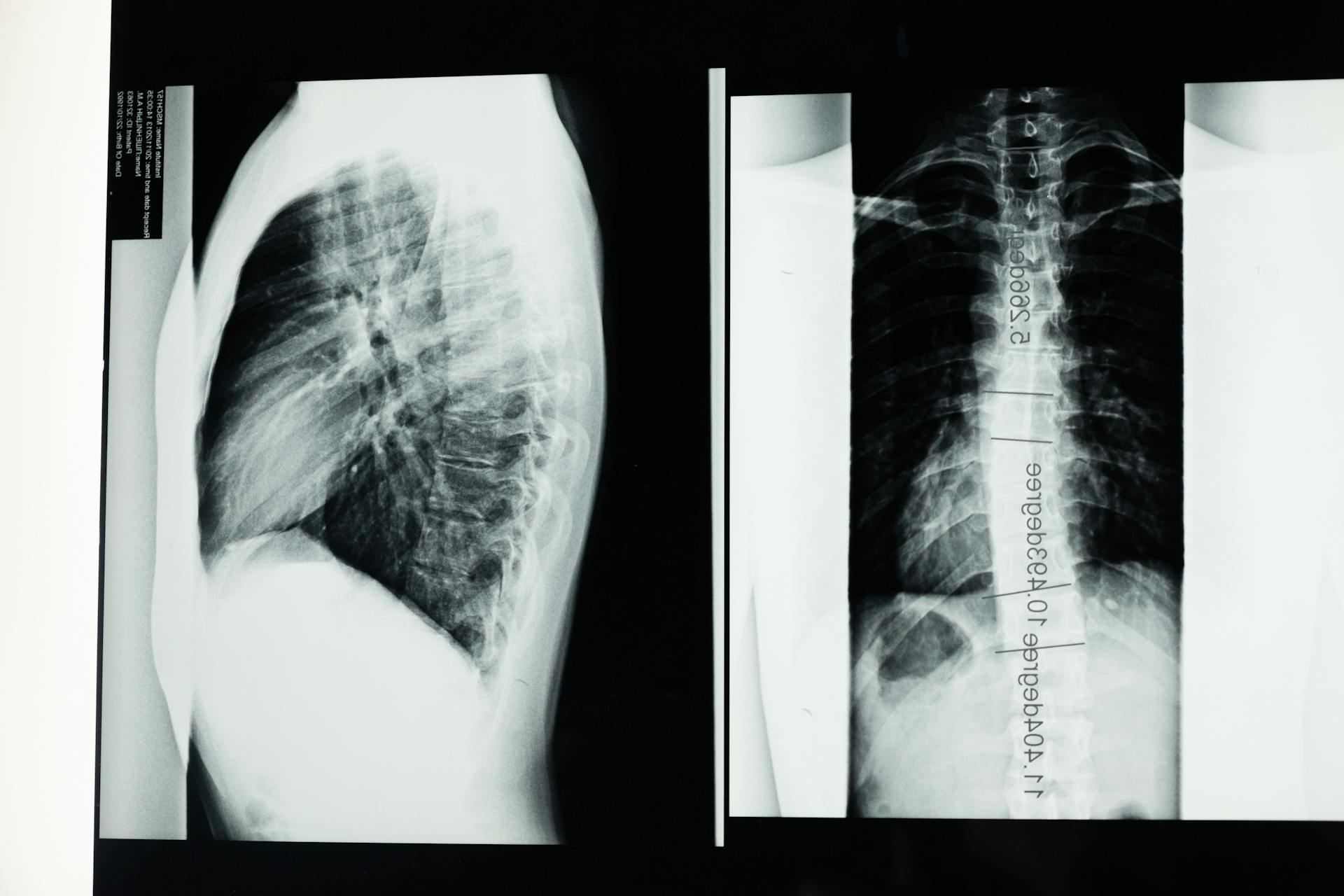
The short answer. A spinal disc is the cushion that sits between two vertebrae, the bones of the spine1,3. Each disc has a tough outer ring, the annulus fibrosus, and a soft, gel-like center, the nucleus pulposus1,3. An adult spine has 23 of them1. Discs change with age, and many of those changes show up on scans of people who have no pain at all9.
The discs, sometimes called back discs or intervertebral discs, sit between the vertebral bodies and link them together2. They let the spine bend and twist, carry the load of body weight and muscle activity, and keep neighboring bones from touching1,2. The American Academy of Orthopaedic Surgeons (AAOS) describes each one as a soft, round cushion that acts like a shock absorber when you walk, run or jump3.
Urban and Roberts call the discs the main joints of the spinal column2. Roberts and colleagues describe the disc's layered structure as what allows movement and flexibility in what would otherwise be a rigid spine5.
Both spellings are in use, and they name the same structure. AAOS and MedlinePlus write "disk"3,4. StatPearls and the lumbar disc nomenclature published by the North American Spine Society and two radiology societies write "disc"1,11. The AAOS "intervertebral disk" and the StatPearls "intervertebral disc" are described with the same two main parts, an annulus fibrosus around a nucleus pulposus1,3. This article uses "disc" except when quoting a source.
The healthy adult disc has few, if any, blood vessels2. At birth there are some vessels in the end plates and annulus, but they soon recede5. The cells inside the disc get oxygen and glucose almost entirely by diffusion from blood vessels at the disc's edges7. Cells in the nucleus may sit as far as 8 mm from the nearest capillaries2. The disc does have some nerves, mainly in the outer layers of the annulus2.
The adult spine has 23 discs: 6 in the neck (cervical), 12 in the upper and mid back (thoracic) and 5 in the lower back (lumbar)1. There is no disc between the first two neck bones, and the lowest disc sits where the lumbar spine meets the sacrum, at L5-S11.
Discs are labeled by the vertebrae on either side, such as L5-S1 for the disc at the junction of the lumbar spine and the sacrum1. The two lowest levels, L4-L5 and L5-S1, were the most common sites in a retrospective review of 601 lumbar herniations12, and patients in a later review of herniation studies mostly had herniations at those same two levels14.
Size depends on where the disc is. In the lower back, discs are about 7 to 10 mm thick (roughly a quarter to three-eighths of an inch) and about 4 cm (roughly 1.5 inches) from front to back2. A CT study of 48 healthy people found the disc space was tallest at L2-L3, at 10 mm, and shortest at T1-T2, at 2.85 mm8. In an MRI study of the lower lumbar spine, men had larger discs than women, and L5-S1 discs were the smallest of the three levels measured15.
Stacked together, the discs make up a large share of the spine's length. StatPearls puts it at about 25% to 33%1; Urban and Roberts put it at one-third2.
Urban and Roberts write that the disc shows degenerative and aging changes earlier than any other connective tissue in the body2. Very mild changes have been described in discs from children as young as 22.
With age, the disc loses water and the makeup of its proteoglycans changes5. The nucleus becomes less gel-like and more fibrous, and cracks and fissures eventually form5. As the nucleus loses pressure and dries out, the disc loses height6. AAOS puts it plainly: as water content drops, disks become less flexible, begin to shrink and become more likely to tear or bulge3.
Researchers still debate where normal aging ends and disease begins. One review notes discussion about whether aging and degeneration are separate processes or the same process on a different timescale5. Another proposes that "degenerative disc disease" should only describe a degenerate disc that is also painful10. The same review lists genetic inheritance, age, poor nutrient supply to the disc and loading history as underlying causes10, and two twin studies found heritability above 60%2. Several studies have reported that disc degeneration and herniation run strongly in families2.
Scans make this easy to misread. In a systematic review of imaging in 3,110 people with no symptoms, disc degeneration was found in 37% of 20-year-olds and 96% of 80-year-olds9. The authors concluded that many of these findings are likely part of normal aging and not linked to pain9.
A herniated disc happens when the soft center pushes through the tough outer ring3. This can happen slowly from wear and tear or suddenly after an injury3. The center may push all the way through the ring, or it may make the ring bulge3. Disc material can press on nearby nerves and also releases chemical irritants that inflame them3. For more detail, see our post on whether you have a herniated disc.
The lower back is the most common place for a herniated disc, the neck is second, and the thoracic spine is rarely involved4. Sources differ on who is most affected. AAOS says men between 20 and 503, while MedlinePlus says middle-aged and older men4. In a retrospective review of 601 cases, lumbar herniation became less common in the elderly, especially after age 8012.
AAOS lists these risk factors3:
Low back pain is usually the first symptom3. Pressure on a nerve can cause sciatica, a sharp, shooting pain from the buttock down the back of one leg, along with numbness, tingling or weakness in the leg or foot3. Loss of bladder or bowel control is extremely rare, and it is a medical emergency3.
The outlook is often good. AAOS says most patients are free of symptoms by 3 to 4 months, and that only a small percentage need surgery3. In many cases, the herniated material is absorbed by the body over time3. A meta-analysis of 11 cohort studies put the rate of this spontaneous resorption at about 67% with conservative care13. A later review found the chance depended on the type of herniation, from 13.3% for bulging discs to 93.0% for the type called sequestered14. These figures come from studies that followed patients with repeat MRI scans, so they describe what happened on imaging rather than a promise for any one person14. With or without surgery, AAOS puts the lifetime chance of the same disc herniating again at up to 20% to 25%3.
MedlinePlus advises contacting a provider for severe back pain that does not go away, or for any numbness, loss of movement, weakness, or bowel or bladder changes4. AAOS describes loss of bladder or bowel control as a medical emergency that needs immediate attention3.
If you are in the Santa Barbara area, Dr. Scheinberg can examine your back, review any imaging and walk you through the options. See spine and back care or call (805) 682-1394.
Short answers to the questions patients ask most.
Have a question about your own situation?
Call (805) 682-1394Reviewed by Dr. Richard Scheinberg, MD, a board-certified orthopedic surgeon in Santa Barbara with 40 years of surgical experience.