The short answer. Bone marrow aspirate concentrate (BMAC) and platelet-rich plasma (PRP) are injections made from your own bone marrow and blood. Studies in knee osteoarthritis have found that patients' pain and function improved after BMAC1,2, and a 2025 analysis of 18 randomized trials found that PRP gave a clinically meaningful improvement in function for up to 12 months3. Long-term studies have also followed patients who went many years without a joint replacement after bone marrow concentrate or PRP4,5,6. For rheumatoid arthritis, early studies of PRP have found less pain and better function7,8.
Osteoarthritis is a degenerative joint disease in which the tissues of the joint, including the cartilage that covers the ends of the bones, break down over time9. It becomes more common with age, and the knees and hips are among the joints it most often affects9. Rheumatoid arthritis is a long-lasting autoimmune disease: the immune system attacks the body's own tissues, causing pain, swelling and stiffness in the joints10. Its main treatment is disease-modifying medication7.
Most of the BMAC and PRP research is in osteoarthritis, and that is where this article spends most of its time. For rheumatoid arthritis, a 2022 review of PRP found that most studies showed less pain, lower levels of inflammatory markers and better function, with no severe side effects reported7. In a randomized trial of 60 people with rheumatoid arthritis, patients received either three monthly PRP injections or a single steroid (cortisone) injection. Both groups improved at 3 months, and in the PRP group the improvement lasted to 6 months8. Stem cell trials in rheumatoid arthritis have tested mesenchymal stem cell products, from donors or from the patient, and found them safe and well tolerated, with improvements in symptoms and significant drops in inflammatory markers such as C-reactive protein11. A 2025 review of 42 randomized trials concluded that mesenchymal stem cell treatment may improve rheumatoid arthritis and did not increase adverse events12.
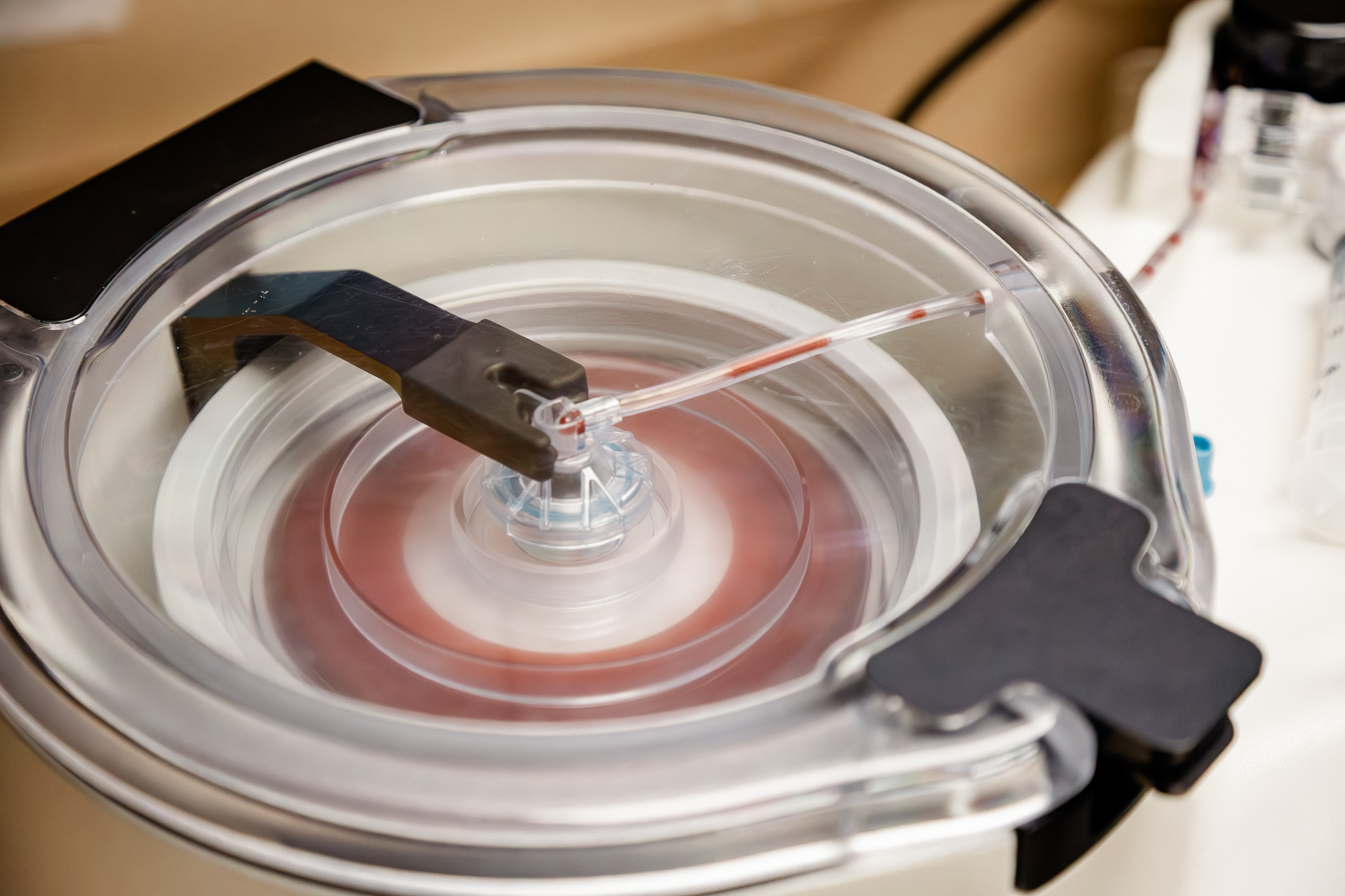
PRP is made by drawing blood from a vein and spinning it in a centrifuge to concentrate the platelets13. BMAC starts with bone marrow drawn from the back of the pelvis (the iliac crest), which is concentrated the same way13. BMAC contains mesenchymal stem cells, which is why it is often called a stem cell treatment5,14.
The two products are not the same. When researchers measured both from the same patients, the bone marrow concentrate had a significantly higher level of an anti-inflammatory protein (interleukin-1 receptor antagonist), while leukocyte-rich PRP had higher levels of several growth factors13. The researchers concluded that bone marrow concentrate is a clinically relevant source of anti-inflammatory biologic therapy that may be more effective in treating osteoarthritis because of that protein, and that leukocyte-rich PRP may be the better fit where more blood supply and healing are wanted, such as in muscle and tendon13. That difference is the reason they are sometimes combined, as in our combined approach. Read more about BMAC and PRP.
At this practice, BMAC is performed at Pueblo Surgery Center, a free-standing AAAHC-accredited outpatient facility at the same address as the office, 401 Chapala St in Santa Barbara.
Most of the research is on the knee.
BMAC. A 2024 review of eight randomized trials with 937 patients found that pain and function improved after BMAC, starting about one month after the injection. BMAC gave better pain scores than hyaluronic acid (viscosupplementation) at 6 and 12 months, and no serious adverse events linked to BMAC were reported1. An earlier review of eight studies (299 knees) found that 34 of the 36 patient-reported outcomes measured improved significantly, and concluded that BMAC is effective in improving pain and patient-reported outcomes in the short to middle term2. In a randomized trial of 175 patients with knee arthritis (Kellgren-Lawrence grades II to IV), BMAC, PRP and hyaluronic acid were all safe and patients in every group improved at 12 months. The BMAC group improved more than the hyaluronic acid group, and more than the PRP group on most scores15. A 2025 review reported that BMAC has shown effectiveness in clinical trials in improving function for people with knee arthritis14.
PRP. A 2025 meta-analysis of 18 randomized trials (1,995 patients) found that PRP gave a clinically meaningful improvement in function at 1, 3, 6 and 12 months and in pain at 3 and 6 months, with higher-platelet preparations giving more pain relief and longer-lasting gains in function3. A 2021 meta-analysis of 34 randomized trials found that PRP gave better function scores than hyaluronic acid at 6 and 12 months, and better pain, daily function and quality of life than steroid injections at 6 months. Its authors concluded that PRP injections gave better results than other injectable options, with a benefit that increased over time16. The American Academy of Orthopaedic Surgeons' knee osteoarthritis guideline states that PRP may reduce pain and improve function in patients with symptomatic knee osteoarthritis17.
In an 89-patient study where PRP, BMAC or fat-derived stem cells were chosen according to the stage of arthritis, all three groups improved on every score at every follow-up18.
Both have helped patients in studies, and their contents differ. In the 175-patient randomized trial above, patients who received BMAC improved more than those who received PRP on most scores at 12 months15. The laboratory comparison above found more of an anti-inflammatory protein in bone marrow concentrate and more growth factors in leukocyte-rich PRP13.
For the two given together, studies have found that patients improved. In a randomized trial of 48 patients with moderate to moderate-severe knee arthritis, bone marrow concentrate with platelet products did better than an exercise program at 3 months, and after treatment patients' scores on most measures stayed improved over their starting point through two years. No serious adverse events were reported19. In a report of three patients who received a BMAC injection followed by a PRP injection one month later, pain and function improved in all three20.
For hip osteoarthritis, studies of BMAC have also found improvement. A 2024 systematic review found five studies with 182 patients in total: pain, function and quality of life improved, and no adverse events were reported21. A 2024 meta-analysis of four studies found that pain improved at 3, 6 and 12 months after bone marrow injections into the hip, along with quality of life22. In a pilot study of 18 hips, a single bone marrow concentrate injection lowered pain with activity from 8 to 4.5 on a 10-point scale and improved WOMAC scores from 31 to 16 (lower is better) over 6 months. All patients kept their improvement at 6 months, and no serious adverse events were reported from the harvest or the injection23. A 2025 review of 36 studies of hip injections, including PRP and BMAC, found that patients' reported outcomes improved overall after treatment24.
Several long-term studies have looked at this, and their results are encouraging.
Delay is a reasonable goal to discuss for a well-chosen patient. No injection can promise that surgery will be avoided. More on this in our overview of joint preservation.
This article does not list the practice's own prices. These are published national figures:
These numbers are not directly comparable. The injection figures are prices quoted to patients, and such centers usually charge patients out of pocket27,28. The surgery figures are Medicare costs.
The useful question is whether a reasonable cost is worth the outcome you can reasonably expect. That is a conversation for a consultation, and candidacy is decided there before any financial commitment.
At this practice, physical therapy and viscosupplementation come first. PRP, BMAC or the two combined may be considered when those have not worked, and not every patient is a candidate.
Several studies suggest that timing and preparation matter. In the hip study, the benefit was clearest in mild osteoarthritis and with higher cell doses, and the authors pointed to treatment before advanced disease5. In the PRP study, arthritis severity and age both affected how well PRP delayed surgery6, and in the PRP meta-analysis, higher-platelet preparations did better3.
If you are in the Santa Barbara area and want to know whether BMAC or PRP fits your knee or hip, Dr. Scheinberg can review your history and imaging with you. Call (805) 682-1394.
Short answers to the questions patients ask most.
Have a question about your own situation?
Call (805) 682-1394Early research is encouraging. A 2022 review found that most studies of PRP in rheumatoid arthritis showed less pain and better function with no severe side effects7, and in a 60-patient randomized trial the benefit of PRP lasted longer than that of a steroid injection8. Rheumatoid arthritis is treated first with disease-modifying medication7.
Reviewed by Dr. Richard Scheinberg, MD, a board-certified orthopedic surgeon in Santa Barbara with 40 years of surgical experience.