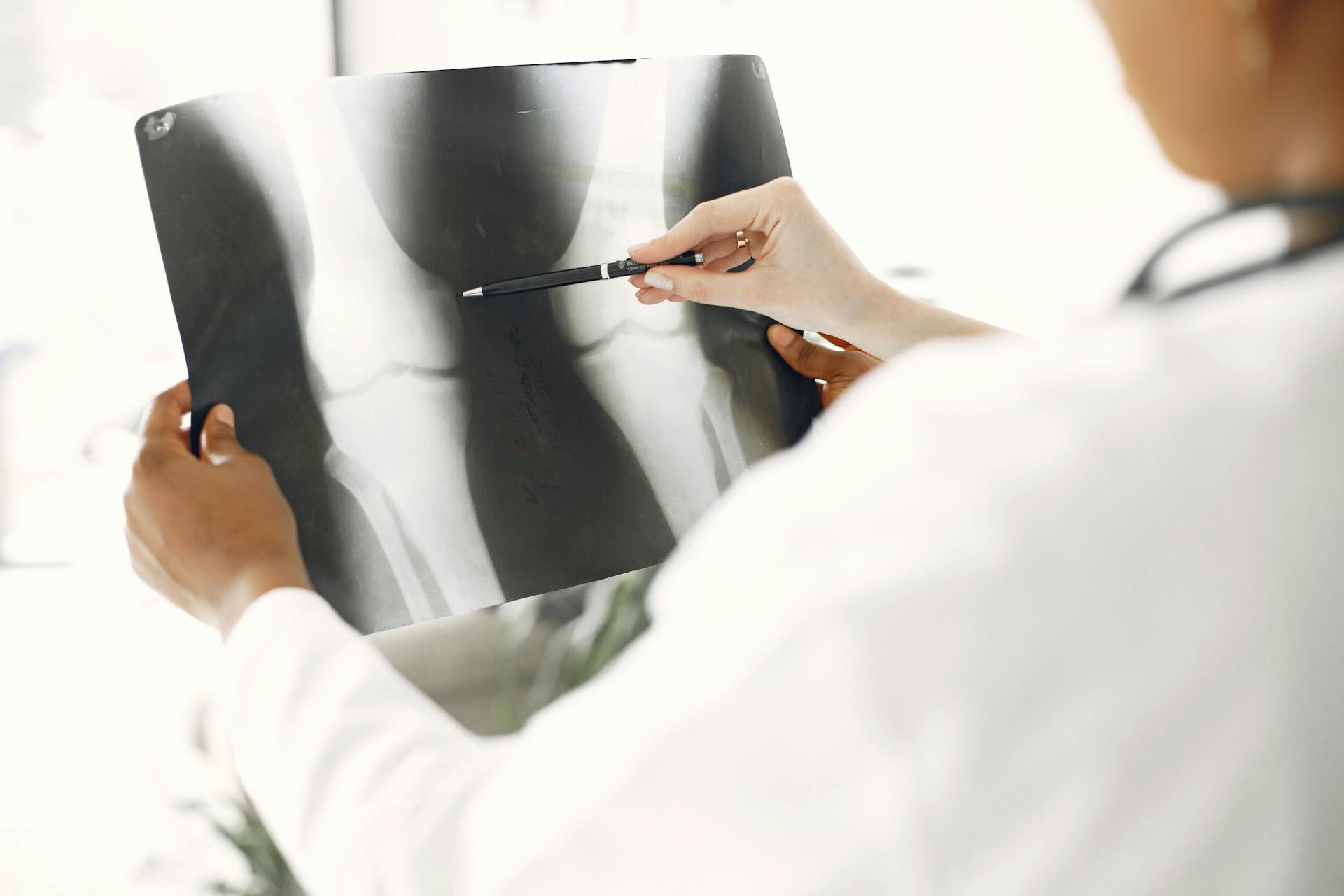
The short answer. A total knee replacement resurfaces the worn ends of the thighbone and shinbone with metal parts and a plastic spacer1. Most people resume most everyday activities within 3 to 6 weeks, but full recovery takes 4 months to a year1,3. Registry data suggest about 82% of knee replacements last 25 years4, and the AAOS says most people get a dramatic reduction in knee pain and a significant improvement in everyday activities1.
The American Academy of Orthopaedic Surgeons (AAOS) describes it as closer to a knee "resurfacing," because only the surfaces of the bones are replaced1. The surgeon removes the damaged cartilage at the ends of the thighbone (femur) and shinbone (tibia) with a small amount of bone underneath, replaces it with metal parts, and places a medical-grade plastic spacer between them so they glide smoothly. The underside of the kneecap may also be resurfaced with a plastic button, though some surgeons skip this step depending on the case1. The operation usually takes 1 to 2 hours1.
More than 700,000 total knee replacements are performed each year in the US, according to the AAOS1.
People who benefit from a knee replacement often have1:
There are no absolute age or weight limits. Most patients are between 50 and 80, and the recommendation rests on pain and disability rather than age1. MedlinePlus notes that younger patients may put extra stress on the new knee, so it may wear out sooner3.
You will not feel pain during the operation. It is done under general anesthesia or under spinal, epidural or regional nerve block anesthesia, which numbs you from the waist down1,3.
Afterward, some pain is a natural part of healing. Your doctor may combine several medicines, and sometimes nerve blocks, to control pain while limiting the need for opioids1. Some pain with activity and at night is common for several weeks after surgery1. The AAOS advises talking to your doctor if your pain has not begun to improve within a few days1.
Some people go home the same day. Others stay in the hospital, typically for 1 to 3 days, depending on how quickly they recover2. Before going home you should be able to get in and out of bed on your own, walk on a level surface with a cane, walker or crutches, manage two or three stairs, and do your home exercises2. If that is not yet possible, a short stay in a rehabilitation or skilled nursing center may be arranged2.
Recovery starts quickly and finishes slowly:
The AAOS advises continuing the exercises from your physical therapist for at least 2 months after surgery2.
More than 90% of modern knee replacements are still working well 15 years after surgery1,3. A 2019 analysis of national joint registries, covering 299,291 knee replacements, estimated that about 82% last 25 years4.
Age matters. In a large population study of hip and knee replacements, the lifetime risk of needing a second operation (a revision) was about 5% for people who had surgery after age 70. For younger patients it rose, reaching up to 35% for men who had surgery in their early 50s5.
The AAOS says most people who have a total knee replacement get a dramatic reduction in knee pain and a significant improvement in their ability to do common activities of daily living1. It also says most patients experience excellent pain relief after the operation1.
Expectations matter. The AAOS notes that a knee replacement will not let you do more than you could before you developed arthritis1, so it helps to talk through which activities you want to get back to before surgery.
The AAOS calls the complication rate low. Serious complications such as a joint infection occur in fewer than 2% of patients, and heart attack or stroke are rarer still1. Risks to know about include1:
For context, in a randomized trial of 100 people eligible for a knee replacement, the surgery group had more serious adverse events than a group given non-surgical treatment alone (24 vs. 6)6.
Realistic activities include unlimited walking, swimming, golf, driving, light hiking, biking and ballroom dancing1. Most surgeons advise against high-impact activities such as running, jogging and jumping for life, because excess activity or weight can speed up wear on the plastic spacer1.
Some differences are normal. Full motion is uncommon, kneeling may be uncomfortable but is not harmful, clicking is common, and the implant may set off metal detectors1.
Knee replacement is generally considered when other treatments no longer help1,3. In the trial mentioned above, surgery followed by 12 weeks of non-surgical care gave more pain relief and better function at 12 months than the non-surgical care alone6. After two years, though, two out of three people in the non-surgical group had not had the operation7. MedlinePlus notes the importance of not having surgery too early or too late3. See non-surgical treatment for knee arthritis for the options and the evidence behind them.
A study of 58,809 Medicare patients who had a knee replacement between 2010 and 2014 found a median cost of $23,800 for the 90 days after surgery8. This is a national figure, not a quote from any practice. For comparison with non-surgical options, see knee arthritis treatment options and what they cost.
If you are in the Santa Barbara area, Dr. Scheinberg can examine your knee, review any imaging and talk through the options. See knee conditions or call (805) 682-1394.
Short answers to the questions patients ask most.
Have a question about your own situation?
Call (805) 682-1394Yes. The AAOS says kneeling is sometimes uncomfortable but is not harmful1.
Reviewed by Dr. Richard Scheinberg, MD, a board-certified orthopedic surgeon in Santa Barbara with 40 years of surgical experience.