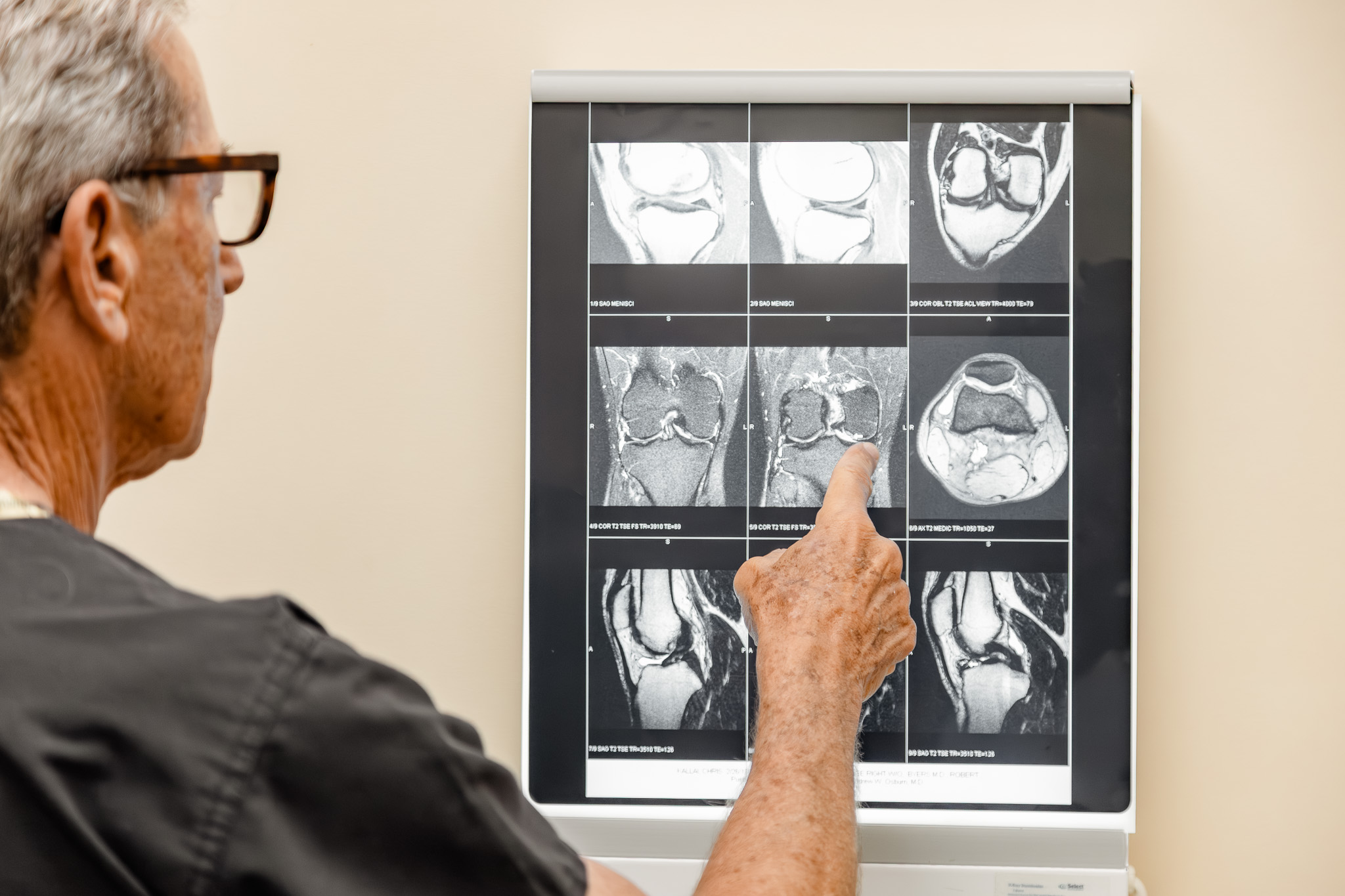
The short answer. Orthobiologic injections such as platelet-rich plasma (PRP) and bone marrow aspirate concentrate (BMAC) are prepared from your own blood or bone marrow and injected into the arthritic knee. Studies have found that patients improved in pain and function after both treatments1,2, and several long-term studies followed people who went years after an orthobiologic injection without needing a knee replacement3,4,5. For a well-chosen patient, they are an option worth discussing before surgery.
This article is about orthobiologics specifically. For every nonsurgical option, including weight loss, exercise, braces and other injections, see how to avoid knee replacement.
This article covers two orthobiologic injections, both prepared from your own body:
At this practice, BMAC is performed at Pueblo Surgery Center, a free-standing, AAAHC-accredited outpatient facility at the same address as the office. The marrow is drawn, processed and delivered in one visit, under light anesthesia so there is no discomfort during the harvest. Read more about PRP, BMAC and the combined approach.
Regenerative treatments such as these are not yet FDA approved for orthopedic conditions7.
Studies have found that patients improved after PRP. A 2025 review pooled 18 randomized trials with 1,995 patients. PRP gave clinically meaningful improvement in knee function at 1, 3, 6 and 12 months and in pain at 3 and 6 months1. Platelet concentration mattered: preparations with more platelets gave meaningful pain relief out to 12 months and longer-lasting gains in function1.
The American Academy of Orthopaedic Surgeons (AAOS) knee arthritis guideline states that PRP may reduce pain and improve function in people with knee arthritis8. In the guideline's pooled analysis of four trials, PRP showed a clinically significant advantage over hyaluronic acid on a standard arthritis score (the WOMAC) at 9 to 12 months, and patients who had PRP kept their improvement past six months8. The guideline also noted that a course of three PRP injections appears to give more favorable results8.
The AAOS patient guide says more and more research is showing the effectiveness of PRP for low- to moderate-grade knee arthritis, with some studies showing results lasting up to two years6. It lists several factors that can influence how well PRP works6:
The risks are described as minimal. There may be increased pain at the injection site, and the rate of other problems, such as infection, tissue damage or nerve injury, appears to be no different from that of cortisone injections6.
A 2024 review of eight randomized trials with 937 patients found that people treated with BMAC improved significantly in pain and function, starting one month after the injection2. Compared with hyaluronic acid, BMAC gave better pain scores at 6 and 12 months2. No serious adverse events linked to BMAC were reported across those trials2.
BMAC has also been studied in severe arthritis. A 2024 study followed 37 knees with advanced arthritis (Kellgren-Lawrence grade III or IV) for four years after a BMAC injection5. By the end of the four years, scores for pain and function had improved significantly, 35 of the 37 knees had improved from the first follow-up to the last, and walking distance had improved5. None of the knees needed a replacement during those four years5.
Several long-term studies have looked at exactly this question:
Viscosupplementation, which this practice uses before orthobiologics, has been studied for delay as well. A 2022 review of observational studies found that people who had hyaluronic acid injections went 9.8 months longer between an arthritis diagnosis and a knee replacement than those who did not9.
Delaying surgery is a reasonable goal to discuss for a well-chosen patient. More on this approach in joint preservation.
These are published national figures, not this practice's prices:
The useful question is whether a reasonable cost is worth the outcome you can realistically expect, including time you may gain before surgery. That is a conversation for a consultation, and candidacy is decided before any financial commitment.
At this practice, physical therapy and viscosupplementation come first. PRP, BMAC or the two combined may be considered when those have not worked. Not every patient is a candidate, and a proper orthopedic evaluation is essential. The AAOS patient guide describes PRP's effectiveness in low- to moderate-grade knee arthritis6, and the four-year BMAC study above followed people with severe arthritis5, so the severity of your arthritis is part of the decision.
If you are in the Santa Barbara area, Dr. Scheinberg can examine the knee, review any imaging and talk through whether an orthobiologic is worth trying. See knee conditions or call (805) 682-1394.
Short answers to the questions patients ask most.
Have a question about your own situation?
Call (805) 682-1394Studies suggest they can for some people. In a Spanish study of 667 patients, 85.7% of those treated with PRP in 2014 had not had a knee replacement five years later, and those who did have one had delayed it by a median of 5.3 years3.
It has been studied there. In a four-year study of 37 knees with advanced arthritis, scores improved significantly, 35 of the 37 knees improved and none needed a replacement during the study5.
Reviewed by Dr. Richard Scheinberg, MD, a board-certified orthopedic surgeon in Santa Barbara with 40 years of surgical experience.