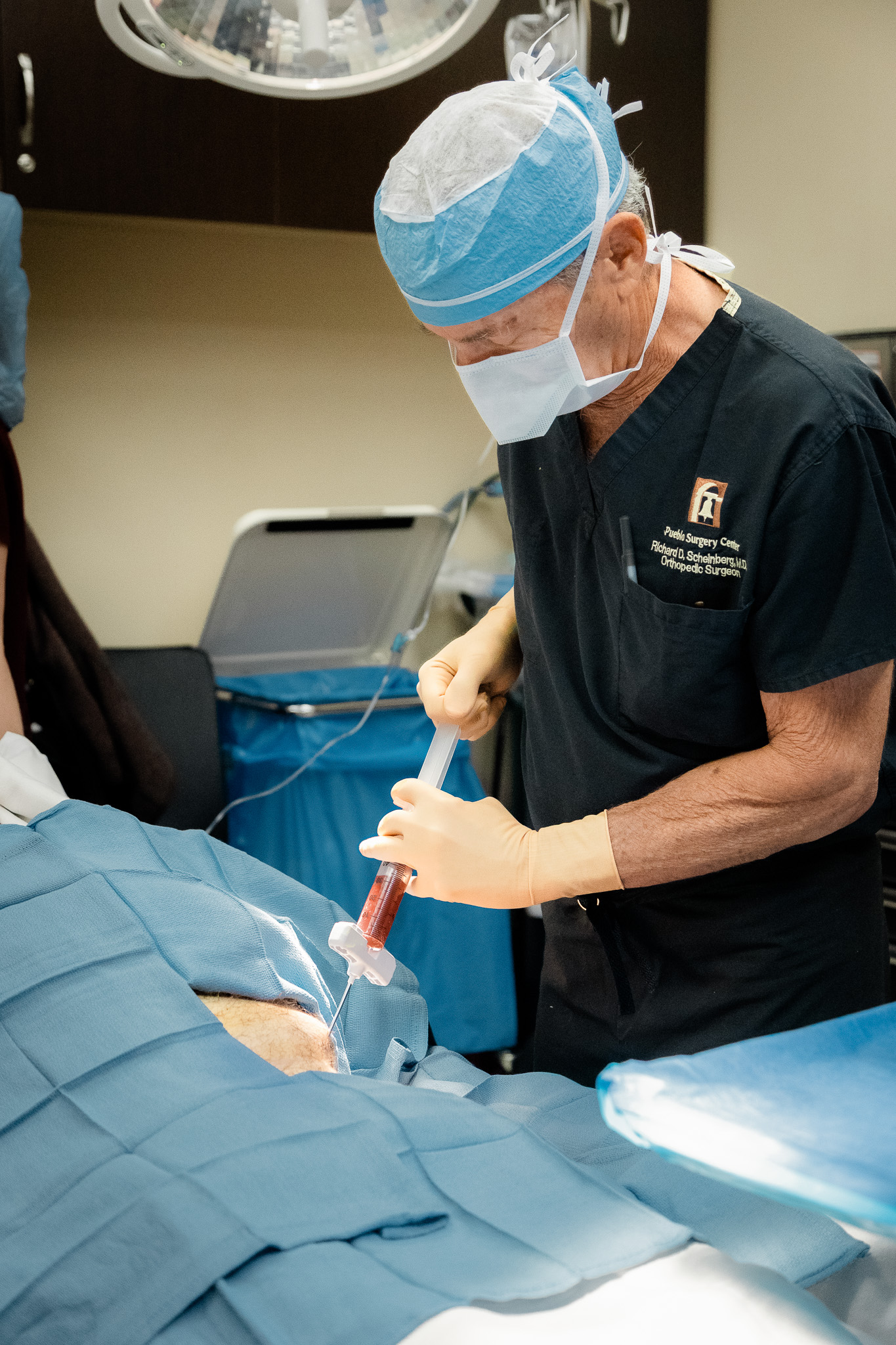
The short answer. Image guidance, usually ultrasound, places a needle where it is aimed more often than feeling for landmarks does, in the knee, hip and shoulder1,2,3,4. In knee arthritis trials, guided injections also led to less pain and better function5,6, and in a randomized trial of PRP injected into the jaw joint, ultrasound-guided PRP reached the joint every time and patients had better results at six months7. PRP itself has been studied widely for knee arthritis, and a meta-analysis of 18 randomized trials found patients improved more with PRP than with hyaluronic acid8.
Yes. A position statement from the American Medical Society for Sports Medicine rated the evidence that ultrasound-guided injections are more accurate than landmark-guided ones at its highest level (A)1.
A "landmark-guided" or "blind" injection means the clinician finds the target by feeling bony points on the surface. Guided injections use live imaging, most often ultrasound, to watch the needle reach the target. Here is how the two compared in systematic reviews:
| Joint | Image-guided accuracy | Landmark-guided accuracy | Source |
|---|---|---|---|
| Knee (ultrasound, pooled studies) | 95.8% | 77.8% | [2] |
| Hip (weighted mean) | 100% | 72% | [3] |
| Shoulder, main joint (single study) | 92.5% | 72.5% | [4] |
| Shoulder, AC joint (three studies) | 93.6% | 68.2% | [4] |
| Shoulder, biceps tendon sheath (single study) | 86.7% | 26.7% | [4] |
Landmark technique has limits. In one study, a single orthopedic surgeon gave 240 knee injections in knees without extra fluid, and imaging checked where each one went. First-attempt accuracy was 71%, 75% or 93% depending on the entry point used9. A review of nine studies found that even the most accurate landmark approach to the knee, at 91%, still placed a substantial number of needles outside the joint10. A review of 17 studies found accuracy was greater with ultrasound guidance regardless of the part of the body treated11.
The hip is harder to reach by feel. It sits deep, near major nerves and blood vessels, with few landmarks you can feel through the skin, which is why ultrasound guidance suits it well12.
In several joints, studies found that it does.
Knee. A 2024 meta-analysis of four randomized trials (338 people with knee osteoarthritis) found ultrasound-guided injections led to less pain during the procedure, less pain at follow-up and better function than landmark-guided injections, and one study in it found higher patient satisfaction5. In an earlier randomized trial, 94 arthritic knees received cortisone injected one way or the other. Compared with the landmark group, the ultrasound group had 48% less pain during the procedure and 42% lower pain scores at follow-up, its responder rate more than doubled, and relief lasted 36% longer6. In a second trial by the same group, in 64 knees with extra fluid, ultrasound guidance led to 48% less procedural pain, nearly three times as much fluid drawn off, and lower pain two weeks later13.
Shoulder. A 2015 meta-analysis found that, for injections into the space above the rotator cuff (the subacromial space), the ultrasound group had significantly greater pain reduction and better function at six weeks, based on three studies. One study of injections around the biceps tendon found the same pattern4.
Across joints. A 2018 review found that ultrasound-guided injections gave better results than landmark-guided ones at the main shoulder joint, the subacromial space, the biceps tendon sheath, the hand and wrist, and at the knee, ankle and foot14. The earlier review of 17 studies found that short-term improvement (under six weeks) was greatest with ultrasound-guided joint injections11.
The sports medicine position statement rated the evidence that guided injections work better at moderate (B), and also found them more cost-effective (B)1. In the knee trial of 94 knees, guidance lowered the cost per responder per year by 58% for a hospital outpatient6.
Most of the guidance trials above tested cortisone or hyaluronic acid. PRP has been tested the same way in the jaw joint. In a double-blind randomized trial of 64 patients with jaw arthritis or disc problems, each received a single PRP injection, placed either with ultrasound or by feel. Ultrasound-guided PRP reached the joint 100% of the time, compared with 68.8% by feel. Both groups improved, and the ultrasound group had greater improvement in jaw opening at three and six months, lower pain and better jaw function scores at six months, and higher patient ratings of their own improvement. No serious adverse events occurred7. The authors concluded that ultrasound guidance should be the preferred method for biologic injections into that joint7.
The American Academy of Orthopaedic Surgeons (AAOS) describes PRP as being "carefully injected into the injured area"15. It seems reasonable that a treatment meant to act in a tissue works best when it reaches that tissue, and that is the reasoning behind careful placement of PRP and BMAC.
PRP is made from your own blood. After a blood draw, the platelets are separated and concentrated by spinning the blood in a centrifuge, so the platelet concentration can be 5 to 10 times greater than usual15. Platelets contain growth factors that are important in the healing of injuries15.
There is no one standardized process for preparing PRP, so different PRP products have different compositions. The density of platelets in the plasma, for example, can vary16. AAOS lists the preparation of the PRP, including the cells in the injected material, among the factors that can influence how well it works, alongside the area treated, the patient's overall health and whether the injury is new or long-standing15.
White blood cell content is one of those preparation choices. A meta-analysis of 18 randomized trials found that leukocyte-poor PRP (fewer white blood cells) was associated with significantly better knee function scores than leukocyte-rich PRP8.
Studies have found that patients improved. In a meta-analysis of 18 randomized trials comparing PRP with hyaluronic acid (811 PRP patients and 797 hyaluronic acid patients, followed for about 11 months on average), average improvement on a standard arthritis score was 44.7% with PRP versus 12.6% with hyaluronic acid8. The authors concluded that patients treated with PRP for knee arthritis can be expected to have improved clinical outcomes compared with hyaluronic acid8.
AAOS says that more and more research is showing the effectiveness of PRP in treating low- to moderate-grade knee osteoarthritis, and that some studies have shown these results can last up to two years15. AAOS also reports that PRP is effective in the treatment of chronic tendon injuries, especially tennis elbow15.
On safety, AAOS notes the risks of PRP are minimal. There may be increased pain at the injection site, and the rate of other problems, such as infection, tissue damage or nerve injury, appears no different from that of cortisone injections15. Cleveland Clinic says it can take a few weeks to feel the first results, and the effects may last six months to a year or longer, depending on the condition16.
Because pain can come from more than one place, and the diagnosis decides the treatment. Hip pain, for example, can come from structures inside or outside the joint, from the lower spine or the pelvic floor, or be referred from the bowel, bladder or reproductive organs12.
A standard knee evaluation includes a talk about your symptoms and history, a physical examination, and possibly X-rays, with MRI or CT occasionally needed to see the bone and soft tissues17. The response to an injection can itself help show where pain is coming from and guide who is a candidate for surgery12. And for some people surgery is the right answer: AAOS notes that a doctor may recommend it when arthritis pain causes disability and is not relieved by nonsurgical treatment17.
At our practice, not every patient is a candidate for orthobiologics, and a proper orthopedic evaluation is essential. Candidacy is decided at a consultation, before any financial commitment. Patients outside the area can have the first consultation and follow-ups by telemedicine, with imaging sent by email.
At our practice, physical therapy and viscosupplementation come first. PRP, BMAC or the two combined may be considered when those have not worked.
AAOS also describes nonsurgical treatment as the starting point for knee arthritis, with exercise recommended to improve pain and function17. Viscosupplementation is an injection of hyaluronic acid, a substance found naturally in the fluid around joints, where it acts as a lubricant and a shock absorber. People with osteoarthritis have a lower-than-normal concentration of it in their joints, and the injection is meant to aid movement and reduce pain. It was approved by the U.S. Food and Drug Administration in 1997. It may take several weeks to notice an improvement, and some patients report pain relief for several months18.
When a patient does go on to BMAC, the procedure is performed at Pueblo Surgery Center, a free-standing, AAAHC-accredited outpatient facility at the same address as the office. The marrow is drawn, processed and delivered in one visit, under light anesthesia so there is no discomfort during the harvest.
If you are in the Santa Barbara area, Dr. Scheinberg can examine the joint, review any imaging and talk through the options. See joint preservation or call (805) 682-1394.
Related reading: what to expect during orthobiologic treatment and what PRP is and how it works.
Short answers to the questions patients ask most.
Have a question about your own situation?
Call (805) 682-1394Accuracy depends on technique. One orthopedic surgeon's knee injections without imaging ranged from 71% to 93% accurate by entry point9, while pooled studies put ultrasound-guided knee injections at 95.8%2. In a jaw joint trial, ultrasound-guided PRP reached the joint every time and patients had better results at six months7.
At our practice, physical therapy and viscosupplementation come before PRP or BMAC. AAOS also recommends exercise for knee arthritis to improve pain and function17.
Yes. Patients outside the area can have the first consultation and follow-ups by telemedicine, with imaging sent by email. Candidacy is decided at that consultation, before any financial commitment.
Reviewed by Dr. Richard Scheinberg, MD, a board-certified orthopedic surgeon in Santa Barbara with 40 years of surgical experience.